
4.1 Scope
This Section relates to the use of bamboo in construction as structural elements, nonstructural elements and also for temporary works in structures or elements of the structure, ensuring quality and effectiveness of design and construction using bamboo. It covers minimum strength data, dimensional and grading requirements, seasoning, preservative treatment, design and jointing techniques with bamboo which would facilitate scientific application and long-term performance of structures. It also covers guidelines so as to ensure proper procurement, storage, precautions and design limitations on bamboo.4.2 Terminology
For the purpose of this Section, the following definitions shall apply.4.2.1 Anatomical Purpose Definitions
4.2.2 Structural Purpose Definitions
4.2.3 Definitions Relating to Defects
4.2.4 Definitions Relating to Drying Degrades
4.3 Symbols
For the purpose of this Section, the following letter symbols shall have the meaning indicated against each, unless otherwise stated:- = Cross-sectional area of bamboo (perpendicular to the direction of the principal fibres and vessels), , mm2
- = Outer diameter, mm
- = Inner diameter, mm
- = Modulus of elasticity in bending, N/mm2
- = Calculated stress in axial compression, N/mm2
- = Permissible stress in compression along the fibres, N/mm2
- = Moment of inertia , mm4
- = Unsupported length of column, m or mm
- = Moisture content, %
- = Radius of gyration , mm
- = Modulus of rupture, N/mm2
- = Wall thickness, mm
- = Section modulus, mm3
- = Deflection or deformation, mm.
4.4 Materials
4.4.1 Species of Bamboo
In Bangladesh, four species are widely used, hence studied for the mechanical properties as tabulated in Table 6.4.1-6.4.4 for top, bottom and middle positions. Table 6.4.5 further summarize the average mechanical properties of 21 bamboo species. Table 6.4.1: Moisture content and specific gravity values of bamboo species4.4.2 Grouping
Sixteen species of bamboo are suitable for structural applications and classified into three groups, namely, Group A, Group B and Group C as given in Table 6.4.6. The characteristics of these groups are as given in Table 6.4.6. Species of bamboo other than those listed in the Table 6.4.6 may be used, provided the basic strength characteristics are determined and found more than the limits mentioned therein. However, in the absence of testing facilities and compulsion for use of other species, and for expedient designing, allowable stresses may be arrived at by multiplying density with factors as given in Table 6.4.5.4.4.3 Moisture Content in Bamboo
With decrease of moisture content (M) the strength of bamboo increases exponentially and bamboo has an intersection point (fibre saturation point) at around 25 percent moisture content depending upon the species. Matured culms shall be seasoned to about 20 percent moisture content before use. Table 6.4.5: Physical and Mechanical Properties of Bamboos (in Round Form)4.4.3.1
Air seasoning of split or half-round bamboo does not pose much problem but care has to be taken to prevent fungal discoloration and decay. However, rapid drying in open sun can control decay due to fungal and insect attack. Seasoning in round form presents considerable problem as regards mechanical degrade due to drying defects. A general observation has been that immature bamboo gets invariably deformed in cross-section during seasoning and thick walled immature bamboo generally collapses. Thick mature bamboo tends to crack on the surface, with the cracks originating at the nodes and at the decayed points. Moderately thick immature and thin and moderately thick mature bamboos season with much less degrade. Bamboo having poor initial condition on account of decay, borer holes, etc. generally suffers more drying degrades.4.4.3.2
Accelerated air seasoning method gives good results. In this method, the nodal diaphragms (septa) are punctured to enable thorough passage of hot air from one end of the resulting bamboo tube to the other end.4.4.4 Grading of Structural Bamboo
Grading is sorting out bamboo on the basis of characteristics important for structural utilization as under:- (a) Diameter and length of culm,
- (b) Taper of culm,
- (c) Straightness of culm,
- (d) Inter nodal length,
- (e) Wall thickness,
- (f) Density and strength, and
- (g) Durability and seasoning.
Table 6.4.7: Limiting Strength Values (in Green Condition)
4.4.4.1 Diameter and length
4.4.4.1.1 Gradation according to the Mean Outer Diameter
For structural Group A and Group B species, culms shall be segregated in steps of 10 mm of mean outer diameter as follows: Special Grade Grade I Grade II Grade III For structural Group C species culms shall be segregated in steps of 20 mm of mean outer diameter Grade I Grade II Grade III4.4.4.1.2
The minimum length of culms shall be preferably 6 m for facilitating close fittings at joints.4.4.5 Taper
The taper shall not be more than 5.8 mm per metre length (or 0.58 percent) of bamboo in any grade of bamboo.4.4.5.1 Curvature
The maximum curvature shall not be more than 75 mm in a length of 6 m of any grade of bamboo.4.4.5.2 Wall thickness
Preferably minimum wall thickness of 8 mm shall be used for load bearing members.4.4.5.3 Defects and permissible characteristics
4.4.5.3.1
Dead and immature bamboos, bore/GHOON holes, decay, collapse, checks more than 3 mm in depth, shall be avoided.4.4.5.3.2
Protruded portion of the nodes shall be flushed smooth. Bamboo shall be used after at least six weeks of felling.4.4.5.3.3
Broken, damaged and discolored bamboo shall be rejected.4.4.5.3.4
Matured bamboo of at least 4 years of age shall be used.4.4.6 Durability and Treatability
4.4.6.1 Durability
The natural durability of bamboo is low and varies between 12 months and 36 months depending on the species and climatic conditions. In tropical countries the bio-deterioration is very severe, Bamboos are generally destroyed in about one to two years’ time when used in the open and in contact with ground while a service life of two to five years can be expected from bamboo when used under cover and out of contact with ground. The mechanical strength of bamboo deteriorates rapidly with the onset of fungal decay in the sclerenchymatous fibres. Split bamboo is more rapidly destroyed than round bamboo. For making bamboo durable, suitable treatment shall be given.4.4.6.2 Treatability
Due to difference in the anatomical structure of bamboo as compared to timber, bamboo behaves entirely differently from wood during treatment with preservative. Bamboos are difficult to treat by normal preservation methods in dry condition and therefore treatment is best carried out in green condition.4.4.6.3 Boucherie Process
In this process of preservative treatment, water borne preservative is applied to end surface of green bamboo through a suitable chamber and forced through the bamboo by hydrostatic or other pressure.4.4.6.3.1 Performance of treated bamboo
Trials with treated bamboos have indicated varied durability depending upon the actual location of use. The performance in partially exposed and under covered conditions is better.4.4.6.3.2
For provisions on safety of bamboo structures against fire, see Part 7.4.5 Permissible Stresses
4.5.1 Factor of Safety
The safety factor for deriving stresses of bamboo shall be as under:4.5.2 Coefficient of Variation
The coefficient of variation (in percent) shall be as under:4.5.3
Solid bamboos or bamboos whose wall thickness ( w ) is comparatively more and bamboos which are generally known as male bamboos having nodes very closer and growing on ridges are often considered good for structural purposes.4.5.4
The safe working stresses for 18 species of bamboos are given in Table 4.5.64.5.5
For change in duration of load other than continuous (long-term), the permissible stresses given in Table 4.5.6 shall be multiplied by the modification factors given below:4.6 Design Considerations
4.6.1
All structural members, assemblies or framework in a building shall be capable of sustaining, without exceeding the limits of stress specified, the worst combination of all loadings. A fundamental aspect of design will be to determine the forces to which the structure/structural element might be subjected to, starting from the roof and working down to the soil by transferring the forces through various components and connections. Accepted principles of mechanics for analysis and specified design procedures shall be applied (see Chapter 11 Part 6).4.6.2
Unlike timber, bamboo properties do not relate well to species, being dependent among other factors, on position of the culm, geographic location and age. The practice in timber engineering is to base designs on safe working stresses and the same may be adopted to bamboo with the limitations that practical experience rather than precise calculations generally govern the detailing.4.6.3 Net Section
It is determined by passing a plane or a series of connected planes transversely through the members. Least net sectional area is used for calculating load carrying capacity of a member.4.6.4 Loads
The loads shall be in accordance with Chapter 2 Part 6.4.6.5 Structural Forms
4.6.5.1
Main structural components in bamboo may include roof and floor diaphragms, shear walls, wall panellings, beams, piles, columns, etc. Both from the point of view of capacity and deformation, trusses and framed skeletons are much better applications of bamboo.4.6.5.2 Schematization of bamboo as a structural material
This shall be based on the principles of engineering mechanics involving the following assumptions and practices:- (a) The elastic behaviour of bamboo, till failure; (plastic behaviour being considered insignificant);
- (b) Bamboo culms are analysed on mean wall thickness basis as hollow tube structure (not perfectly straight) member on mean diameter basis;
- (c) The structural elements of bamboo shall be appropriately supported near the nodes of culm as and where the structural system demands. The joints in the design shall be located near nodes; and
- (d) Bamboo structures be designed like any other conventional structural elements taking care of details with regards to supports and joints; they shall be considered to generally act as a hinge, unless substantiating data justify a fixed joint.
4.6.6 Flexural Members
4.6.6.1
All flexural members maybe designed using the principles of beam theory.4.6.6.2
The tendency of bamboo beams to acquire a large deflection under long continuous loadings due to possible plastic flow, if any shall be taken care of. Permanent load may be doubled for calculation of deflection under sustained load (including creep) in case of green bamboo having moisture content exceeding 15 percent.4.6.6.3
The moment of inertia, I shall be determined as follows:- (a) The outside diameter and the wall thickness should be measured at both ends, correct up to 1 mm for diameter of culm and 0.1 mm for the wall thickness. (For each cross-section the diameter shall be taken twice, in direction perpendicular to each other and so the wall thickness shall be taken as four times, in the same places as the diameter has been taken twice.)
- (b) With these values the mean diameter and the mean thickness for the middle of the beam shall be calculated and moment of inertia determined.
4.6.6.4
The maximum bending stress shall be calculated and compared with the allowable stress.4.6.6.5
For shear checks, conventional design procedure in accordance with Chapter 11 Part 6 shall be followed. The basic shear stress values (N/mm2 ) for five species of bamboo in split form in green condition can be assumed as under:4.6.6.6
Forces acting on a beam, being loads or reaction forces at supports, shall act in nodes or as near to nodes as by any means possible.4.6.7 Bamboo Column (Predominantly Loaded in Axial Direction)
4.6.7.1
Columns and struts are essential components sustaining compressive forces in a structure. They transfer load to the supporting media.4.6.7.2
Design of columns shall be based on one of the following two criteria:- (a) Full scale buckling tests on the same species, size and other relevant variables.
- (b) Calculations, based on the following:
- (i) The moment of inertia shall be as per Sec 4.6.6.3.
- (ii) For bamboo columns the best available straight bamboo culms shall be selected. Structural bamboo components in compression should be kept under a slenderness ratio of 50.
- (iii) The bending stresses due to initial curvature, eccentricities and induced deflection shall be taken into account, in addition to those due to any lateral load.
4.6.7.3
Buckling calculation shall be according to Euler, with a reduction to 90 percent of moment of inertia, to take into account the effect of the taper, provided the reduced diameter is not less than 0.6 percent.4.6.7.4
For strength and stability, larger diameter thick walled sections of bamboo with closely spaced nodes shall be used, alternatively, smaller sections may be tied together as a bundle-column.4.6.8 Assemblies, Roof Trusses
4.6.8.1
A truss is essentially a plane structure which is very stiff in the plane of the members, that is the plane in which it is expected to carry load, but very flexible in every other direction. Roof truss generally consists of a number of triangulated frames, the members of which are fastened at ends and the nature of stresses at joints are either tensile or compressive and designed as pin-ended joints [see Figure 6.4.1.(a)]. Bamboo trusses may also be formed using bamboo mat board or bamboo mat-veneer composite or plywood gusset [see Figure 6.4.1(b)].4.6.8.2
Truss shall be analysed from principles of structural mechanics for the determination of axial forces in members. For the influence of eccentricities, due allowance shall be made in design.4.6.8.3
The truss height shall exceed 0.15 times the span in case of a triangular truss (pitched roofing) and 0.10 times the span in case of a rectangular (parallel) truss.4.6.8.4
For members in compression, the effective length for in-plane strength verification shall be taken as the distance between two adjacent points of contraflexure. For fully triangulated trusses, effective length for simple span members without especially rigid end-connection shall be taken as the span length.4.6.8.5
For strength verification of members in compression and connections, the calculated axial forces should be increased by 10 percent.4.6.8.6
The spacing of trusses shall be consistent with use of bamboo purlins (2 m to 3 m).4.6.8.7
The ends in open beams, joists, rafters, purlins shall be suitably plugged. Bamboo roof coverings shall be considered as non-structural in function. The common roof covering shall include bamboo mat board, bamboo mat corrugated sheet, bamboo tiles/strings, plastered bamboo reeds, thatch, corrugated galvanized iron sheeting, plain clay tiles or pan tiles, etc.4.7 Design and Techniques of Joints
4.7.1 Bamboo Joints
Round, tubular form of bamboo requires an approach different to that used for sawn timber. Susceptibility to crushing at the open ends, splitting tendency, variation in diameter, wall thickness and straightness are some of the associated issues which have to be taken care of while designing and detailing the connections with bamboo.4.7.1.1 Traditional practices
Such joining methods revolve around lashing or tying by rope or string with or without pegs or dowels. Such joints lack stiffness and have low efficiency.4.7.1.1.1 Lengthening joints (End Joints)
(a) Lap Joint In this case, end of one piece of bamboo is made to lap over that of the other in line and the whole is suitably fastened. It may be full lapping or half lapping. Full section culms are overlapped by at least one internode and tied together in two or three places. Efficiency could be improved by using bamboo or hardwood dowels. In half lapping, culms shall preferably be of similar diameter and cut longitudinally to half depth over at least one internode length and fastened as per full lap joint (Figure 6.4.2). (b) Butt Joint Culms of similar diameter are butted end to end, interconnected by means of side plates made of quarter round culm of slightly large diameter bamboo, for two or more internode lengths. Assembly shall be fixed and tied preferably with dowel pins. This joint transfers both compressive and tensile forces equally well (Figure 6.4.3). (c) Sleeves and Inserts Short length of bamboo of appropriate diameter may be used either externally or internally to join two culms together (Figure 6.4.4). (d) Scarf Joint A scarf joint is formed by cutting a sloping plane 1 in 4 to 6 on opposite sides from the ends of two similar diameter bamboo culms to be joined. They shall be lapped to form a continuous piece and the assembly suitably fastened by means of lashings. Using hooked splays adds to the strength and proper location of joints (Figure 6.4.5).4.7.1.1.2 Bearing joints
Bearing joints are formed when members which bear against one another or cross each other and transfer the loads at an angle other than parallel to the axis. (a) Butt Joint The simplest form consists of a horizontal member supported directly on top of a vertical member. The top of the post may be cut to form a saddle to ensure proper seating of beam for good load transfer. The saddle should be close to a node to reduce risk of splitting (Figure 6.4.6). (b) Tenon Joint It is formed by cutting a projection (tenon) in walls of one piece of bamboo and filling it into corresponding holes (mortise) in another and keyed. It is a neat and versatile joint for maximum strength and resistance to separation (Figure 6.4.7). (c) Cross-Over Joint It is formed when two or more members cross at right angles and its function is to locate the members and to provide lateral stability. In case of the joint connecting floor beam to post, it maybe load bearing (see Figure 6.4.8). Such joints are also used to transmit angle thrust. (d) Angled Joint When two or more members meet or cross other than at right angles, angled joints are formed. For butt joints, the ends of the members may be shaped to fit in as saddle joints. Tenons would help in strengthening such joints (see Figure 6.4.9).4.7.1.2 Modern practices
Following are some of the modern practices for bamboo jointing (Figure 6.4.10):- (a) Plywood or solid timber gusset plates maybe used at joint assemblies of web and chord connection in a truss and fixed with bamboo pins or bolts. Hollow cavities of bamboo need to be stuffed with wooden plugs.
- (b) Use of wooden inserts to reinforce the ends of the bamboo before forming the joints. Alternatively steel bands clamps with integral bolt/eye may be fitted around bamboo sections for jointing.
4.7.1.3 Fixing methods and fastening devices
In case of butt joints the tie maybe passed through a pre-drilled hole or around hardwood or bamboo pegs or dowels inserted into prefomed holes to act as horns. Pegs are driven from one side, usually at an angle to increase strength and dowels pass right through the member, usually at right angles.4.7.1.3.1
Normally 1.60 mm diameter galvanized iron wire may be used for tight lashing.4.7.1.3.2 Wire Bound Joints
Usually galvanized iron 2.00 mm diameter galvanized iron wire is tightened around the joints by binding the respective pieces together. At least two holes are drilled in each piece and wire is passed through them for good results.4.7.1.3.3 Pin And Wire Bound Joints
Generally 12 mm diameter bamboo pins are fastened to culms and bound by 2.00 mm diameter galvanized iron wire.4.7.1.3.4 Fish Plates/Gusset Plated Joints
At least 25 mm thick hardwood splice plate or 12 mm thick structural grade plywood are used. Solid bamboo pins help in fastening the assembly.4.7.1.3.5 Horned Joints
Two tongues made at one end of culm may be fastened with across member with its mortise grooves to receive horns, the assembly being wire bound.4.7.1.4
For any complete joint alternative for a given load and geometry, description of all fastening elements, their sizes and location shall be indicated. Data shall be based on full scale tests.4.7.1.5
Tests on full scale joints or on components shall be carried out in a recognized laboratory.4.7.1.6
In disaster high wind and seismic areas, good construction practice shall be followed taking care of joints, their damping and possible ductility. Bracings in walls shall be taken care of in bamboo structures.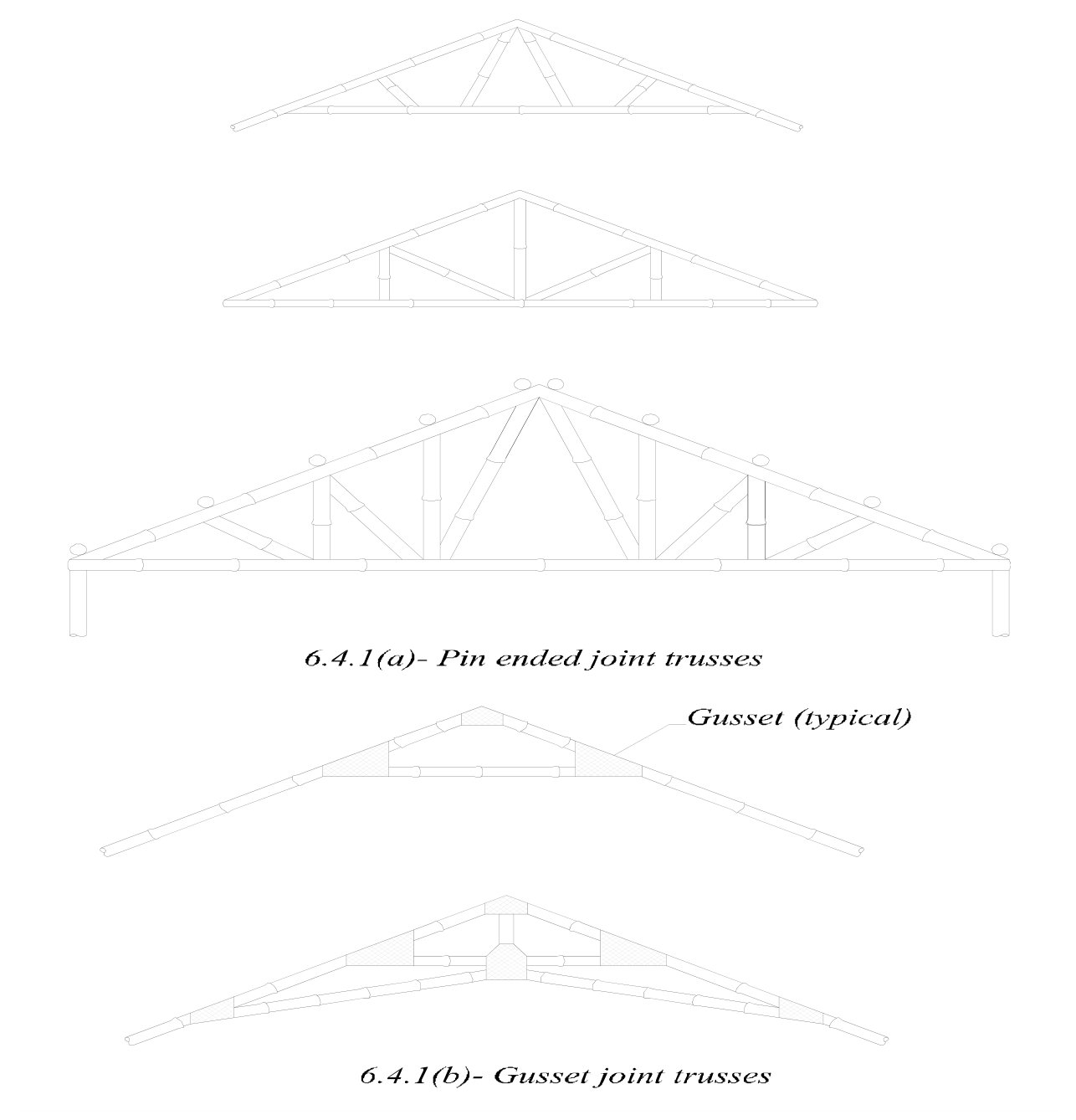
Figure 6.4.1 Some typical configurations for small and large trusses in Bamboo
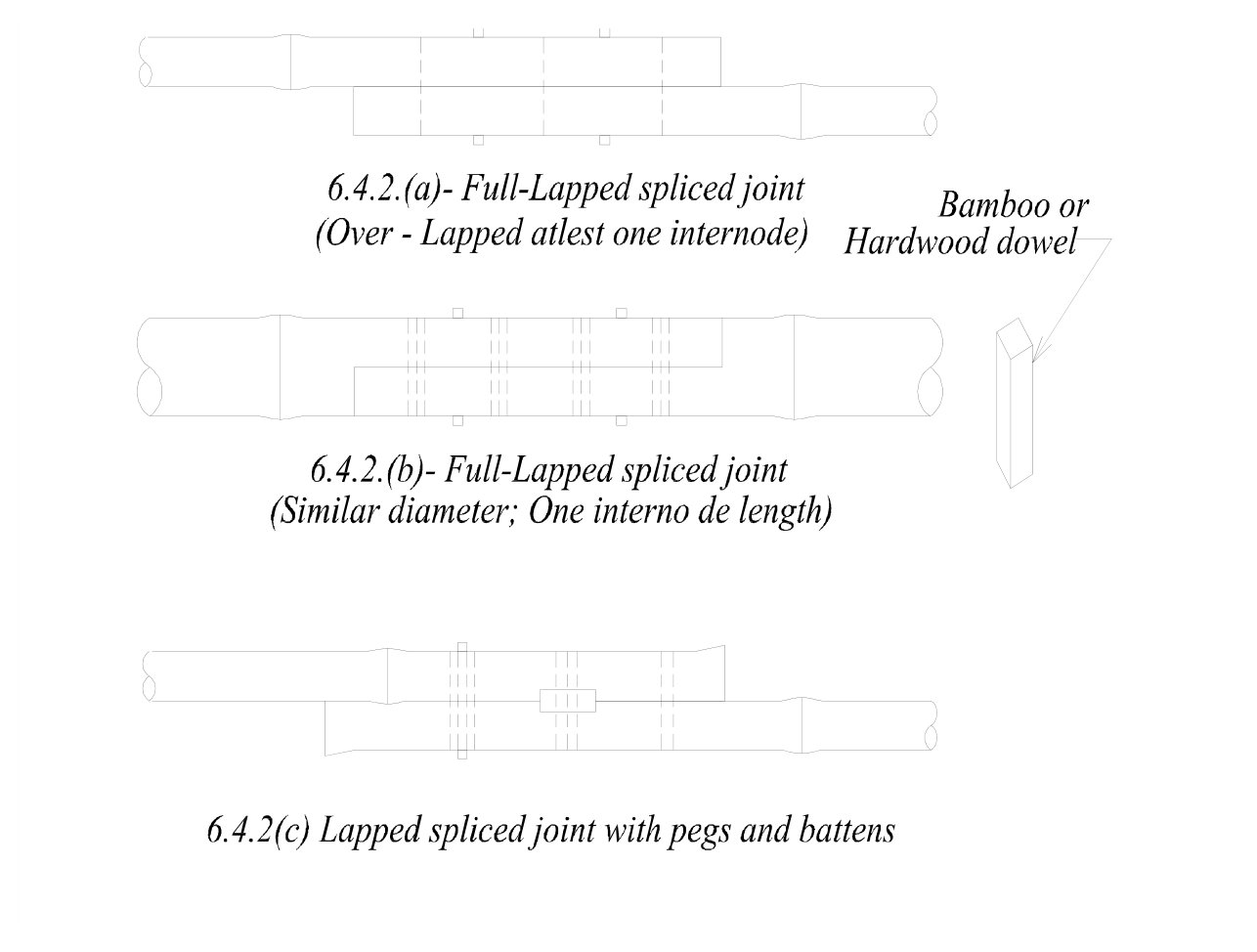
Figure 6.4.2 Lap joint in Bamboo
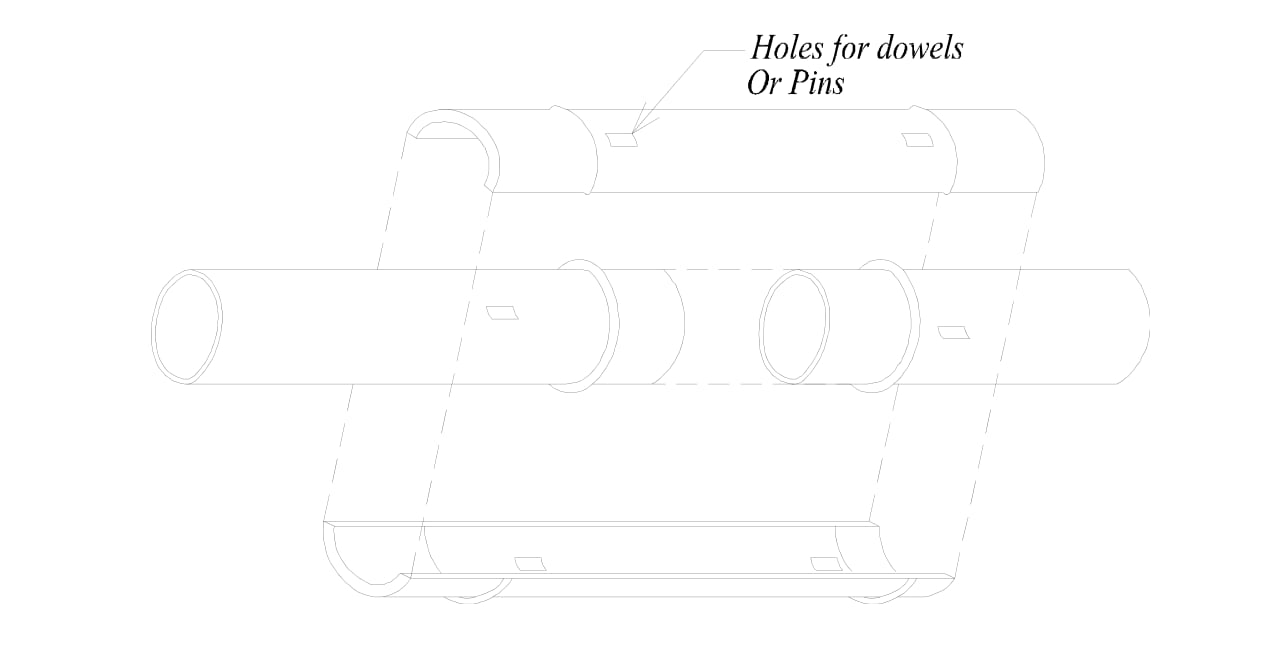
Figure 6.4.3 Butt joint with side plates in Bamboo
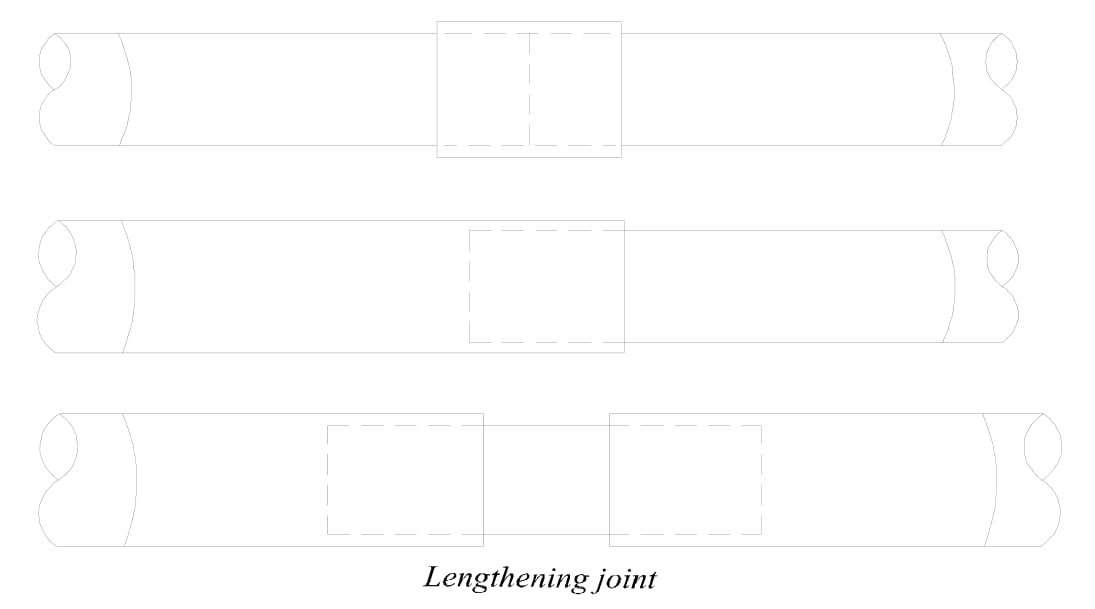
Figure 6.4.4 Sleeves and inserts for Bamboo joint
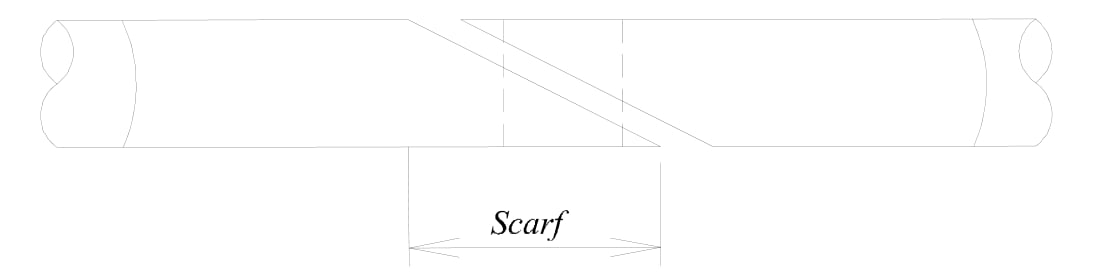
Figure 6.4.5 Scarf joint
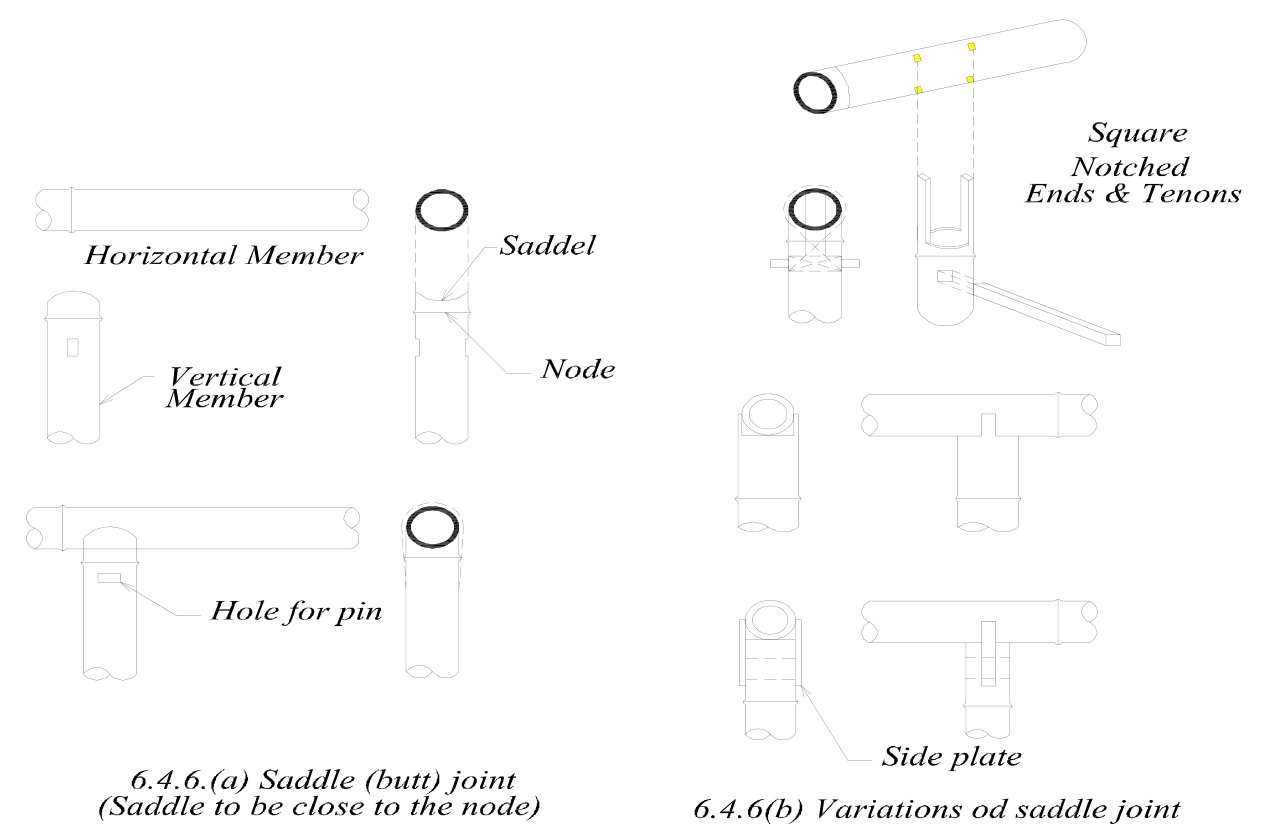
Figure 6.4.6 Butt joints in Bamboo
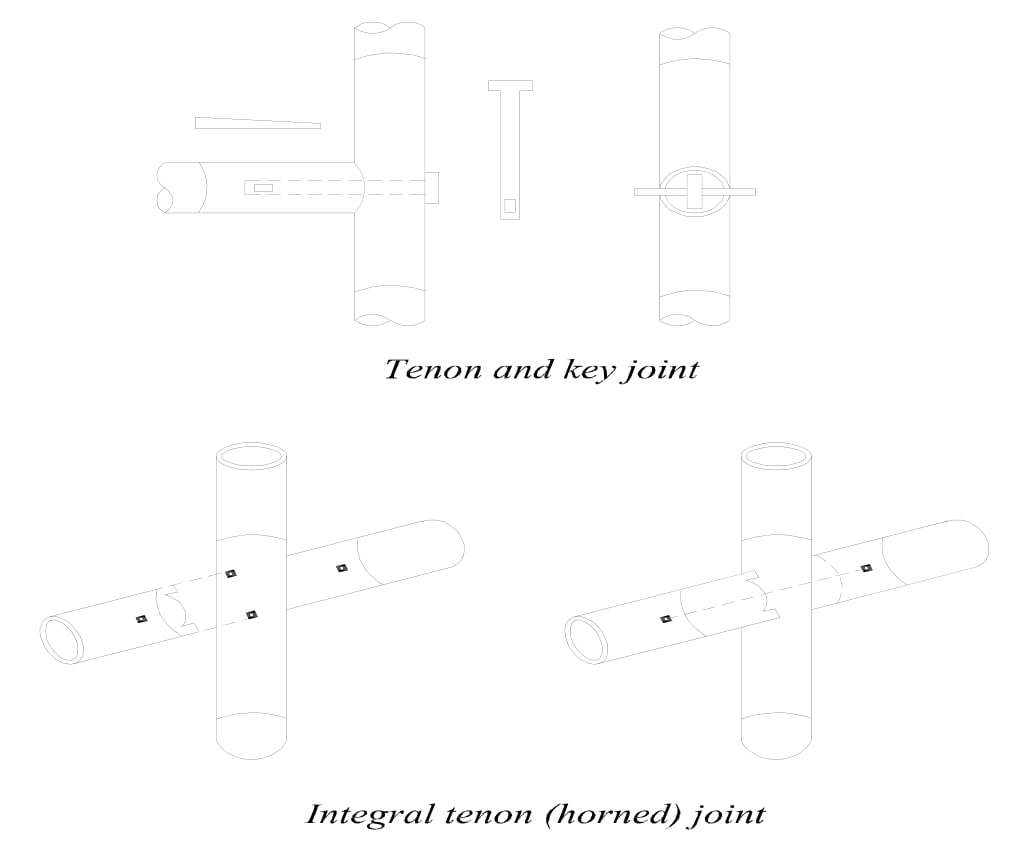
Figure 6.4.7 Tenon joint
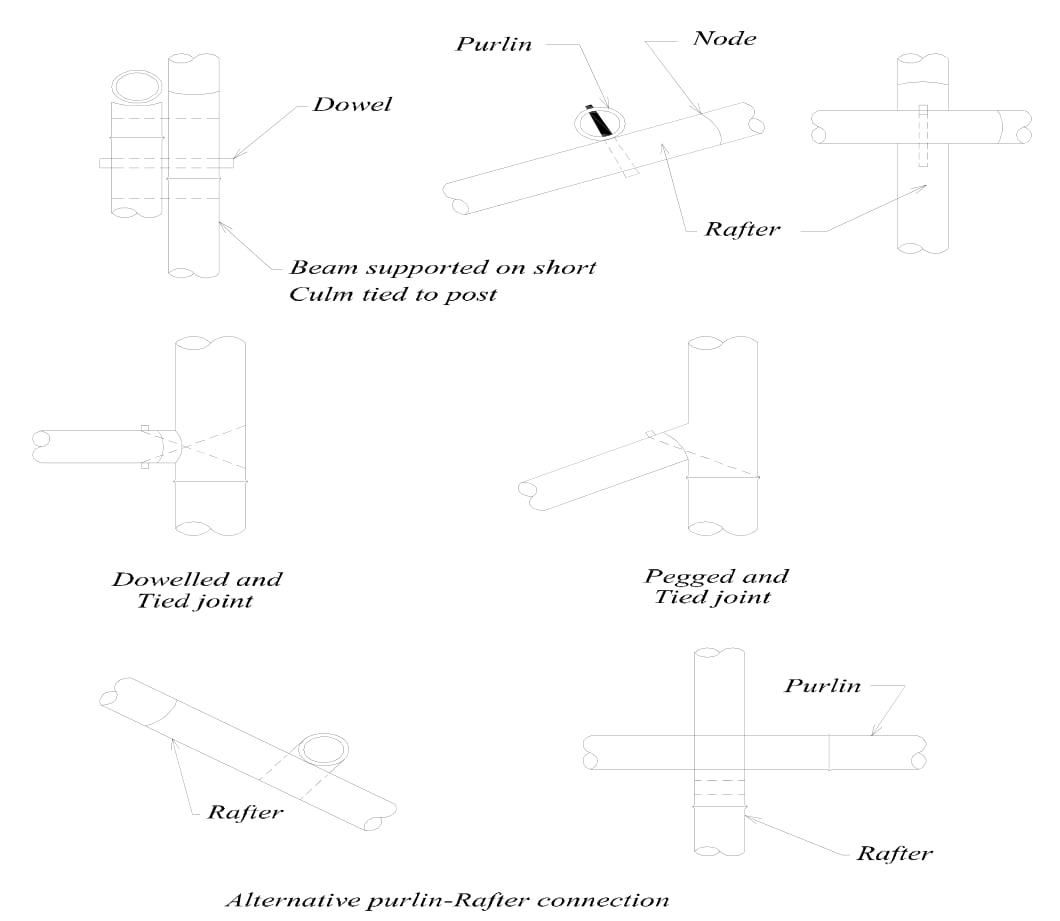
Figure 6.4.8 Cross over joints (Bearing joints)
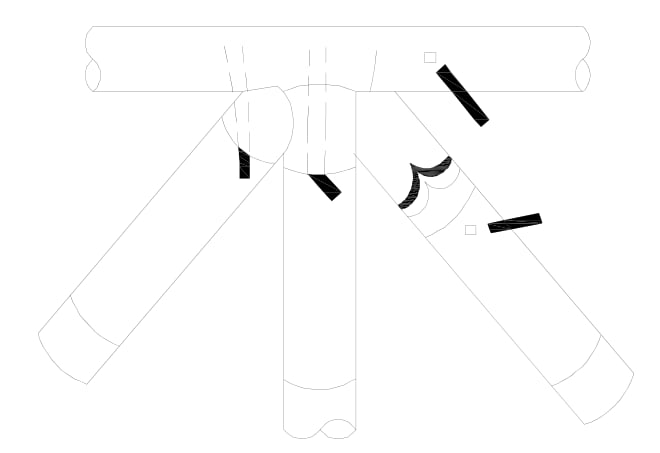
Figure 6.4.9 Angled joints with integral tenons
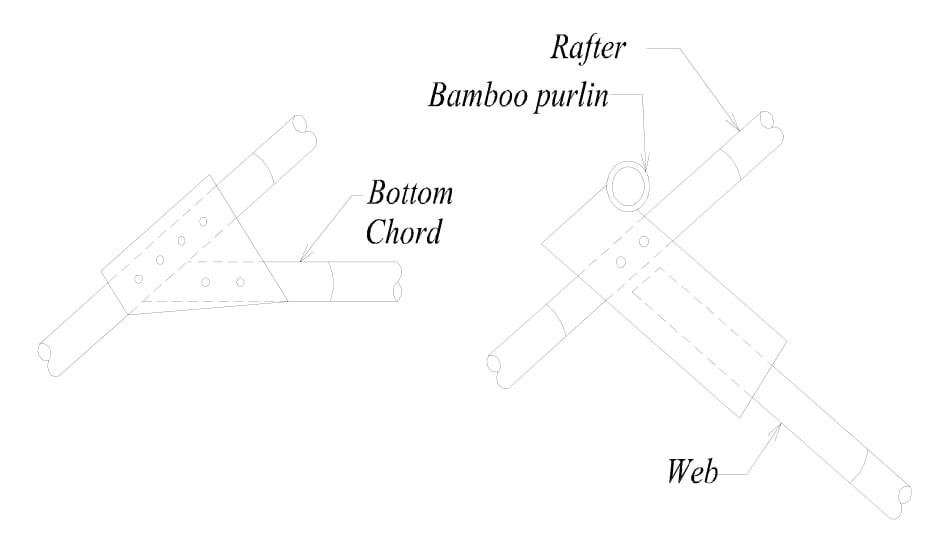
Figure 6.4.10 Gusset plated joint
4.8 Storage of Bamboo
Procurement and storage of bamboo stocks are essential for any project work and shall be done in accordance with Part 7 of this Code.4.9 Related References
- (1) IS 6874: 1973, “Method of Test for Round Bamboo”, Bureau of Indian Standards, India, 1974.
- (2) IS 9096: 1979, “Code of Practice for Preservation of Bamboo for Structural Purposes”, Bureau of Indian Standards, India, 1974.
- (3) Salehuddin, A. B. M., “Unnoto Poddhotite Bash Shongrokkhon o Babohar”, Bangladesh Agriculture Research Institute, 2004.